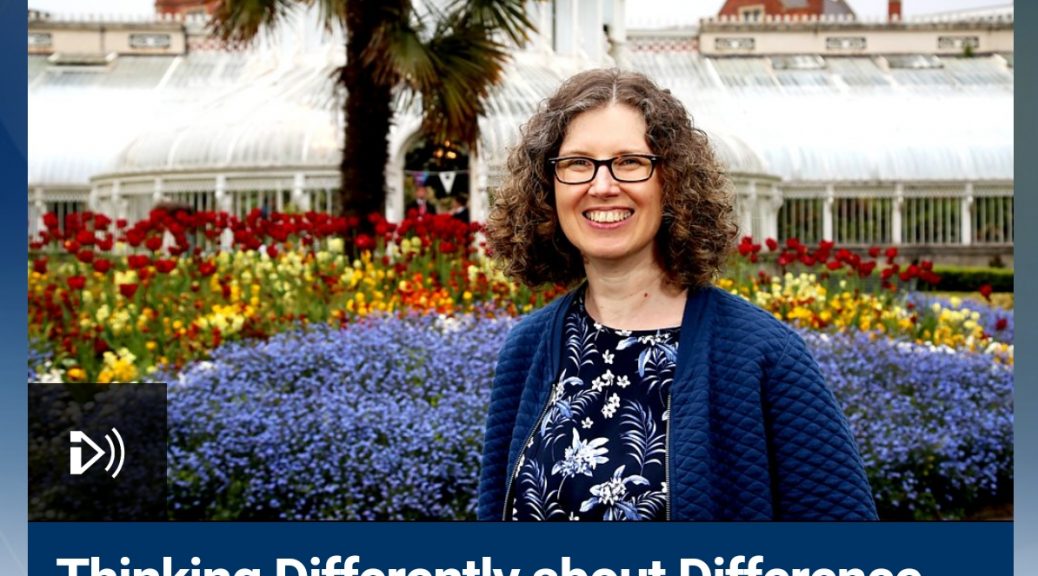
Thinking Differently About Difference by Maura Campbell
My son’s name is Darragh. He’s awesome. He is, in fact, the most beautiful boy in the world. This has been independently verified – by both his grannies. Darragh is also autistic. It’s as much a part of him as his blue eyes and blond curls.
I love how he sees the world. He has his own names for things. We refer to this as ‘Cracking the Darragh Code’. It wasn’t too hard to figure out that ‘Gurget’ meant Rugrats or that ‘Cessity’ meant The Jungle Book. ‘Gwah’ was a bit more of a challenge. We spent two weeks scouring the internet before we figured out that ‘Gwah’ meant Rudolph the Red Nosed Reindeer and the Island of Misfit Toys.
One day Darragh handed me his iPad and asked for ‘Bum Bums’. I said: “I love you with every fibre of my being, son, I really do, but there is no way on God’s green earth I’m typing ‘Bum Bums’ into a search engine…. It turned out he wanted The Fimbles.
People ask us what Darragh’s ‘special ability’ is. I tell them he can eat his own body weight in pizza. My husband tells them he can fly.
Like I say, he’s awesome.
Not everyone sees Darragh the way we do. When we’re out as a family, we get stared at - a lot - and we have to run the gauntlet of intrusive questions. Some people can’t seem to see past the noise-cancelling headphones, the chewy hanging round his neck or the assistance dog standing beside him.
Like the guy who marched straight up to me in a shop and, without a word of introduction, said “What’s wrong with him?”.
Darragh was right there. He may not use conventional speech, but he knows when people are talking about him – his ears aren’t painted on. There was an awkward silence. The man continued to gawp at Darragh, obviously feeling he was entitled to know what my son’s disability was and how it might justify a service dog.
I answered, as calmly as I could, “There’s nothing wrong with him. He’s wonderful.”
I would share with you what I was actually thinking but I strongly suspect it would contravene BBC standards. Autism is a neurological condition. Put simply, Darragh’s brain is wired differently to most people. Being left-handed is also a neurological condition. Hand preference is controlled by the wiring of the brain.
Left-handed people inhabit a world that is set up for the right-handed and are just expected to fit into it. In the past, left-handed kids were forced to write with their right-hand, because that was what was considered ‘normal’. Historically, being left-handed has had negative connotations - gauche, clumsy, unlucky. In medieval times, lefties were even thought to be in league with the devil. (Though that would perhaps explain the phenomenal success of Justin Bieber.)
Another group of people who’ve traditionally had a bad rep is redheads, who make up a similar proportion of the world’s population as autistics. In the Middle Ages, red hair was considered a sign of witchcraft. The ancient Greeks believed that when they died, redheads would turn into vampires. My point is that societal views of what constitutes ‘normal’ can adapt over time.
Autism is thought of by most people as solely a list of deficits. It’s even confused with mental illness, in a similar way to how homosexuality was once seen as a mental disorder. And let’s remember that homosexuality was only declassified as a mental illness by the World Health Organisation in the early nineties.
Words like ‘symptoms’, ‘diagnosis’ and ‘risk’ are used. This is referred to as the medical model of autism. The social model, on the other hand, sees autism as a naturally occurring phenomenon, as opposed to a medical disorder.
The neurodiversity movement, which emerged in the 1990s, is an attempt to reframe autism as a set of neurological differences – a different way of being human, if you like. A well-known phrase within the autism community is that autistics are ‘different, not less’.
Of course, autism is not without its challenges – anxiety, sensory sensitivities, problems with self-organisation, social burnout, for example. But, as with other types of difference, often the problem really stems from other people’s attitudes and prejudices.
There are many myths about autism – the stereotype of a cold, emotionless automaton who doesn’t feel empathy, has no sense of humour and is a tech genius.
This unremittingly negative narrative about autism has fuelled a lucrative industry in snake oil salesmen pedalling so-called ‘cures’.
Unhelpful theories have linked autism to, among other things: breastfeeding, not breastfeeding, caesarean sections, circumcision, older dads, refrigerator mothers, pesticides, vinyl floors, traffic emissions, bacon, broccoli and the Internet.
Most recently, an Indian professor has claimed it’s caused by women wearing jeans. Well, it is genetic…
I personally believe that the positives outweigh the negatives. These often include honesty, directness, loyalty, a strong sense of natural justice, excellent memory, expertise in intense interests, originality, creativity and independent thinking. There are definite advantages to being able to see the world through different eyes.
Darragh also has a learning disability.
Another difference. And one which is arguably even further back in the queue when it comes to acceptance and equality.
It is the last bastion of political incorrectness.
People who would never think to use race, sexual orientation or physical disability as a form of abuse or ridicule find themselves instead using pejorative language linked to intelligence. In most cases, I honestly don’t believe they’re even conscious they’re being disrespectful to people with a learning disability.
If you believe yourself to be a nice person, and you’ve always done something, it can be hard to accept it might not be a nice thing. It’s a form of unconscious bias.
Let me give you an example of the equality double standard which I believe has been hiding in plain sight.
In order to do so, I’m going to use a well-known phrase, but I’m going to change one word in it because it’s a word I just can’t bring myself to say. The phrase is: ‘the noodle in the woodpile’.
I’ve chosen to use the word ‘noodle’ because I know the word I’m substituting it for is hurtful to people of colour. I also know that most people find that word distasteful. Which is why, thankfully, we don’t hear it very often any more, apart from as a form of cultural re-appropriation.
For exactly the same reason, I don’t use the phrase ‘the village idiot’ because I know it can be hurtful to people with an intellectual disability and those of us who care for them.
‘Idiot’, ‘imbecile’ and ‘moron’ were, for many decades, the clinical terms used in the classification of what we today refer to as learning disability or intellectual disability.
The term ‘moron’ was originally conceived by a prominent American eugenicist.
‘Idiot’ happens to be the term that translates directly across to my son’s particular diagnosis.
The clinical use of ‘idiot’, ‘imbecile’ and ‘moron’ was discontinued in the 1970s when they had become corrupted by being used as terms of abuse.
They were replaced by mental retardation, until ‘retarded’ became corrupted, and then with ‘mentally handicapped’, with its origins in the idea of begging ‘cap in hand’. It met a similar fate.
Unfortunately, I see and hear that phrase, ‘the village idiot’, and the labels ‘idiot’, ‘imbecile’ and ‘moron’ all the time. I saw them used several times to criticise Donald Trump for mocking a physically disabled journalist, without a hint of irony.
I would love us to let the ‘the village idiot’ retire, in the same way that we’ve stopped having ‘noodles’ in ‘woodpiles’.
I get that people don’t like their language being policed, I really do.
But freedom of speech is actually about someone’s right to express their opinions and ideas, free from state interference, as opposed to being challenged by their peers on the particular words they choose in order to do that.
It’s the difference between, on the one hand, respecting someone’s right to hold the opinion that they shouldn’t have to share a changing room with gay people and, on the other, challenging them for saying they don’t want to change in front of ‘faggots’.
Because, thank goodness, that’s another word which is just not okay anymore.
I also get that people sometimes use words like ‘idiot’ to mean ‘fool’. If that’s the case, why not just use the word ‘fool’. If that’s what you actually mean, why not say it?
I don’t regard it as an infringement of my civil liberties that there are words we have collectively decided are best avoided, like the N-word or ‘faggot’. I see it as a positive choice.
Freedom of speech is, after all, a qualified right, not an absolute one, and it carries with it corresponding responsibilities.
Nowadays, the term ‘special needs’ is starting to become corrupted, as is ‘autistic’ and ‘on the spectrum’. We can either continue to cycle through replacement euphemisms or – here’s a thought – we can choose to be more respectful to people who are different.
We can choose to stop treating IQ or conformity with a perceived norm as the measure of a human being’s worth.
It’s not an entirely new idea. Through an online campaign, over three quarters of a million people have pledged to eliminate the demeaning use of the word ‘retarded’ and to promote the acceptance and inclusion of people with intellectual disabilities.
Let’s bring back respect. Let’s bring back kind.
If, in the heat of an argument, you’re searching for a word to criticise someone who’s being racist or homophobic or a misogynist, don’t fight fire with fire. Ridicule their opinions or ideas; don’t make it about their IQ or neurology.
Let’s not cherry-pick the minority groups whose human dignity we want to defend.
Darragh and I share more than curly hair and blue eyes. I’m autistic as well.
People ask me what my ‘special ability’ is. I tell them I have x-ray vision. (Nice belly button ring, sir.)
My son and I are being the people we were born to be.
We are different, not less.
One thought on “Thinking Differently About Difference by Maura Campbell”
Thank you for this insightful and thought provoking article. I was ‘diagnosed’ with Aspergers myself two years ago at the age of 66, a year after my daughter. I agree with you that a lot of the problems arise from the attitudes and prejudices of others, many of whom will not make any effort to try and understand what being autistic actually means. I get very angry when people say to me ‘we’re all on the spectrum aren’t we?’, which has been the response of some of my friends. We try to understand neurotypicals; it would be nice if they reciprocated more often. All the best to you and Darragh.